

You gave the feedback. It was honest and insightful. It was kind. It was specific. You even practiced it in the car. And three weeks later, nothing has changed.
So, you assume you said it wrong. You go looking for a better phrase. A softer opener. A cleaner framework. A better delivery.
Here is the thing. You have been optimizing the one part of this that barely matters.
In 2004, Marshall Goldsmith and Howard Morgan went looking for what actually makes leaders improve. They studied more than eleven thousand leaders across eight companies, and gathered 86,000 pieces of feedback from the people who worked with them. A much larger study a decade later found the same pattern
One variable came out on top. It was not the quality of the feedback. The primary driver of improvement was whether anyone followed up.
Skip the follow-up, and a third to nearly half of your coworkers see no change in you at all.
The Mechanism
Prediction error is research name of what’s happening.
Here is the plain language version. Your brain is not a recording device. It is a prediction machine. All day long it guesses what happens next, and then it checks. When the guess matches, nothing happens. No learning. No update. The brain files it and moves on.
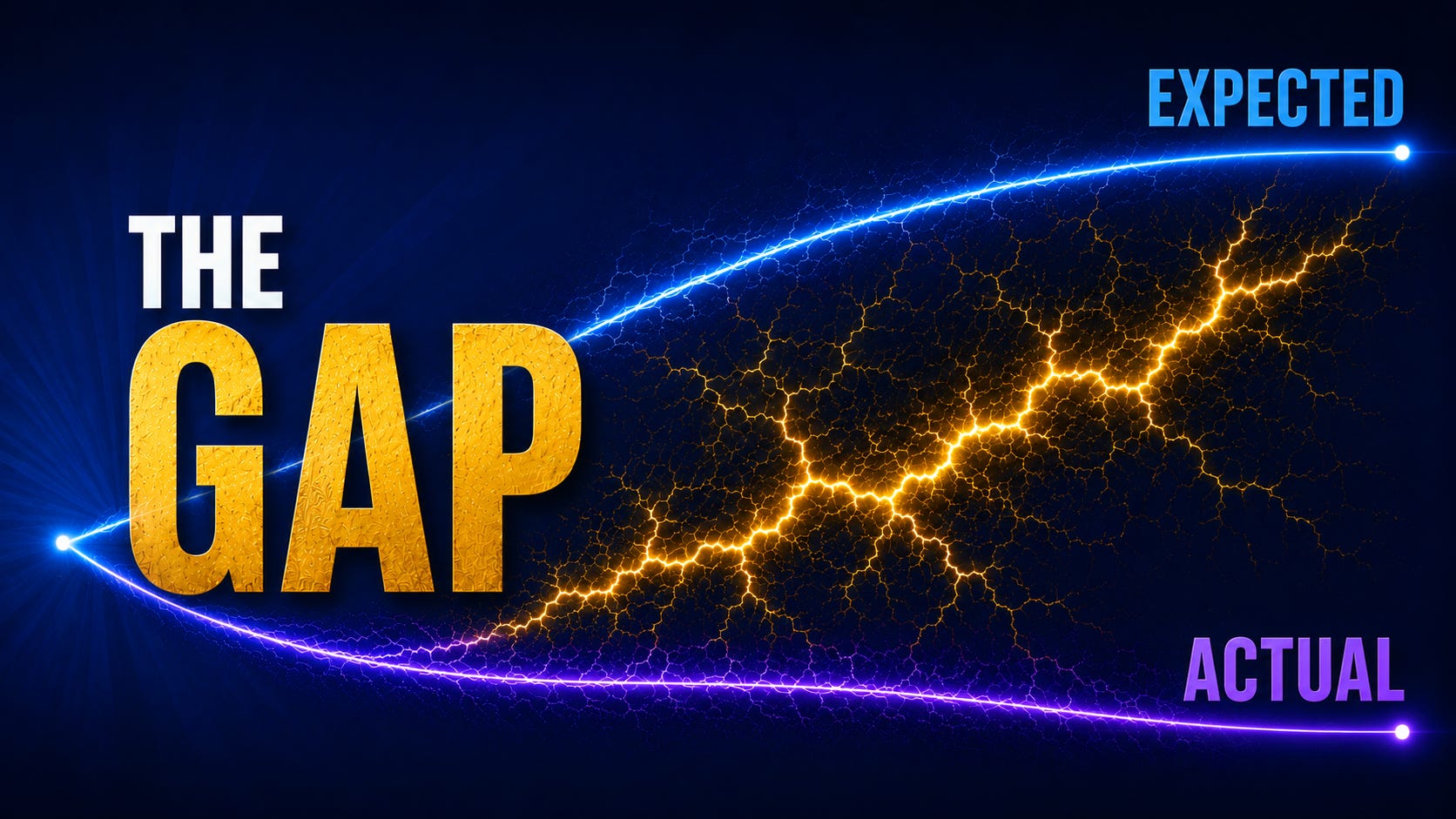
But when the guess misses, something fires. That mismatch between what you expected and what actually occurred is the signal. That gap is where learning lives.
Not the outcome. The gap.
Consider a broken bowl. In Japan there is a practice called kintsugi. When a bowl cracks, they do not hide the seam. They fill it with gold. The break becomes the most striking part of the bowl, and the bowl is worth more repaired than it ever was new.
That is the gap. We treat the space between what we expected and what happened as damage, something to explain away and move past. It is the opposite. The gap is where the gold goes. It is the most valuable part of the whole exchange, and it is the part we keep throwing away.
This is not a management trick. It is the oldest learning rule there is, and it runs far past people. It is how your brain learns. It is also, precisely, how every AI you have ever touched learns. The model makes a prediction, sees what actually happened, and adjusts on the difference. That difference, the gap between expected and actual, is not a metaphor for machine learning. It is the mechanism itself. The same gap trains the most powerful human and AI systems on the planet.
Now put feedback through that lens.
When I give you feedback, I have given you information. I have not given you a gap. You have nothing to check it against yet. You have not tried anything, so you cannot have been wrong about anything.
Feedback is a prediction. The follow up is the check. And that holds whether you are the one giving the feedback or the one getting it.
Why It Fails
Watch what actually happens in the room.
I tell you that you interrupt people in meetings. Receive it. You nod. You mean it. You leave.
And here is where it dies. You now have a prediction: I will handle this. But nothing ever tests it. You go to eleven more meetings. You interrupt in four of them. Nobody says a word.
Your brain does not receive a mismatch. It receives silence. And silence reads as confirmation.
So, your brain quietly concludes the thing is handled. Not because you are lazy. Not because you did not care. Because there was no second conversation. There was no follow-up.
You have watched this at scale. Take two people and send them to the same leadership program. Coach one of them afterward and hand the other the binder. Months later, the coached one has changed and the other has not. Same program. Same information.
The only variable was the follow up. In one study that put a number on it, training alone made managers about twenty percent more effective. Add follow-up coaching and it climbed to roughly 80% more effective. Four times the gain from the same training.
This is why the polished conversation and the clumsy one so often produce the same result, which is none. Both delivered information. Neither shined light on the behavioral gap.
And it is why one of the most upvoted things I have read from actual managers this month was not a request for a better script. It was a man saying the best manager he ever had barely managed him. Seven hundred plus people agreed and could not explain why.
I think this is why. That manager was not louder. He was later. He came back.
The Three Moves
So here is what to do to make feedback more likely to make a difference. Three moves.
Move 1. Stop ending the conversation. Schedule the next one.
Before you leave the room, say this. In two weeks, let’s sit down and go through what you tried.
That does two jobs, and they are the two jobs raw feedback never does. It makes them intentional. They know exactly what to go work on, not communicate better someday, but bring back one thing they tried. And it makes them accountable. They know someone is going to ask, and when. Intention gives them a target. Accountability gives them a deadline.
So be purposeful with that question, because you are priming them. Tell someone in advance what you will ask, and their brain starts working the answer before the meeting arrives. The next two weeks stop being for remembering the feedback and start being for running experiments. Do some research, watch a video, brainstorm some ideas, then pick one and take it for a test drive.
You know this works from the other side of the table. You have sat through the seminar, forty good ideas, and done none of them. Then one time you wrote a single thing on a card, I will try this Tuesday, and that one you did. Specific and chosen beats broad and heard, and there are decades of studies behind it: a concrete plan reliably outperforms a good intention.
A prediction no one will ever check is just a private thought. A prediction with a check on the calendar is a commitment. Two weeks is long enough for real attempts, and short enough that the trail is still warm.
Move 2. Ask what they tried, not how they feel.
Two weeks later, you sit down for that conversation. Here is where most people blow it. They open with a temperature check. How’s it going gets you one word. Good. There is nothing in good to learn from.
So ask three questions. Not mood questions. Behavior questions.
What did you try?
What did you expect to happen?
What actually happened?
Now they are not reporting a mood. They are telling you what they tried, what they expected, and what actually happened. The gap between those last two, between what they predicted and what they got, is the mismatch their brain needed. The gap opens, and it opens inside their head, not yours.
And here is the part most people get backwards. You are no longer the one delivering the correction. They are. There is a name for why that matters. Psychologists call it the generation effect. We remember and we trust what we produce ourselves far more than what we are handed. Slamecka and Graf showed it in 1978, and it has held up ever since. The correction a person reaches on their own outlasts the one you hand them.
So your job just got smaller. Those three questions turn a faint signal into one they cannot ignore. Then get out of the way and let them catch it.
Move 3. Do not wait to be managed well. Close your own loop.
The first two moves assume you are the one giving feedback. This one is for the rest of the time, which is most of the time.
In fact, the higher you rise, the less honest feedback anyone gives you, so the more you have to open this loop yourself.
Here is the part almost nobody tells you. You do not have to wait for a manager who follows up. Most of them never will.
Go back to Goldsmith’s data, because it found something people skip right over. The leaders who improved were not the ones who got the best coaching. They were the ones who asked their own coworkers what they noticed, and then came back to check. The follow up was not a manager behavior. It was a learner behavior.
Which means you can run this entire thing on yourself. Today. Without anyone’s permission. Pick one thing you are working on. Ask two people who see you work: what did you notice, and what would you change. Then put your own check on the calendar, two weeks out, and go back and ask them what moved.
You just opened a loop no one opened for you. That is the move that does not depend on having a great boss. It depends on you deciding to be the one who comes back.
Your One Move
So try one thing this week.
Pick one thing you want to get better at. Then go to one person who sees you work and ask two questions. What did you notice? What would you change?
Then put a date on your own calendar, two weeks out, to go back and ask what moved.
That is it. You are not waiting to be managed well. You are opening the loop yourself.
Here is why it works. Information alone never changed anyone. The follow up is where the gap closes, because it adds the two things information cannot carry: a specific intention, and someone to answer to. The most advanced machine on earth learns the same way, by checking its prediction against what actually happened. Nobody makes a movie about that second conversation. It just happens to be the only one that changes anybody.
Subscribe for weekly ideas on turning research into practical advantage